Product Description
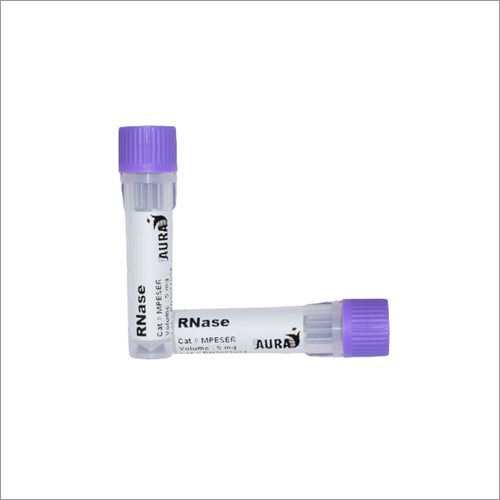
This RNase Pancreatic Ribonuclease catalyzes the breakdown of a phosphodiester bond between a nucleotide's 5'-ribose and the phosphate group connected to the 3'-ribose of a neighboring pyrimidine nucleotide, resulting in the formation of a 2',3'-cyclic phosphate that may subsequently be hydrolyzed to the matching 3'-nucleoside. It is an enzyme that aids in the digestion of RNA in vertebrate species and catalyzes the destruction of RNA. The pH range of 7.0 to 7.5 is ideal for this RNase Pancreatic Ribonuclease to function.
Reliable RNA Degradation for Accurate Molecular AnalysisEmploying RNase Pancreatic Ribonuclease streamlines the removal of unwanted RNA in DNA samples, ensuring cleaner results for mapping and molecular cloning. Its high purity and DNase-free profile prevent contamination, supporting precision in analytical and research applications. The enzyme's optimized stability and activity allow for consistent performance during critical laboratory workflows.
Easy Handling and Versatile Laboratory UseOffered as a dry, lyophilized powder, this enzyme is portable and straightforward to reconstitute in aqueous buffers. It is best stored at -20C to protect activity over its three-year shelf life. Available in varied quantities, it adapts to project sizes from small-scale experiments to larger research undertakings. Researchers benefit from simple integration into existing protocols.
FAQ's of RNase Pancreatic Ribonuclease:
Q: How should RNase Pancreatic Ribonuclease be stored to preserve activity and purity?
A: Store RNase Pancreatic Ribonuclease at -20C in a dry environment, protected from moisture. Proper storage under these conditions ensures the enzyme maintains its activity and purity for up to three years.
Q: What are the main applications of this pancreatic RNase enzyme in the laboratory?
A: The primary uses include degradation and removal of RNA from DNA preparations, RNA mapping, molecular cloning, and analytical experiments where selective RNA cleavage is required for accurate results.
Q: When is RNase Pancreatic Ribonuclease most effective during experimental procedures?
A: The enzyme demonstrates optimal activity at pH 7.0-8.0 and at 25C when used with yeast RNA substrate. It is most effective during processes specifically targeting single-stranded RNA for cleavage.
Q: Where can this enzyme be used and transported?
A: Since RNase Pancreatic Ribonuclease is supplied as a stable dry powder, it is portable and easy to transport. It is intended for laboratory use in research institutes, biotechnology facilities, and analytical laboratories.
Q: What benefits does this product offer over other RNase reagents?
A: This enzyme provides high purity (>90%), stable activity (70 Kunitz units/mg), and a DNase-free profile, reducing the risk of unwanted DNA degradation. Its low endotoxin level makes it suitable for sensitive molecular biology applications.
Q: How is the enzyme activity measured and defined?
A: Enzyme activity is expressed in Kunitz units; one Kunitz unit results in an absorbance increase of 1.0 at 260 nm per minute at pH 5.0 and 25C using yeast RNA as the substrate.
Q: What process should be followed to prepare the enzyme for use in experiments?
A: Reconstitute the lyophilized powder in an appropriate aqueous buffer, ideally at pH 7.0-8.0, for best results. Ensure the solution is freshly prepared and avoid repeated freeze-thaw cycles to maintain full enzyme activity.







 Send Inquiry
 Send Inquiry
 Send SMS


