Product Description
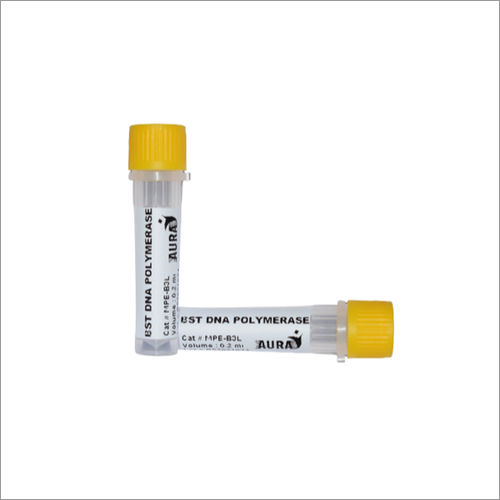
With an aim to be successful in this domain, we are offering a supreme range of BST DNA Polymerase. It is suitable for amplification methods. Apart from this, provided range is able to displays strong strand displacement activity. BST DNA Polymerase is an enzyme derived from the large fragment of Bacillus stearothermophilus. It is suitable for strong strand displacement activity. Provided range is to use in an optimum temperature of 60 C.
Key Features and BenefitsBST DNA Polymerase provides superior strand displacement activity and thermostability, making it the enzyme of choice for isothermal DNA amplification technologies like LAMP. Its high specificity and reliability enable accurate detection of viruses, bacteria, and genetic markers, supporting rapid diagnostic workflows. The enzyme retains efficiency at elevated temperatures and is suitable for both real-time and endpoint analyses, streamlining laboratory operations.
Applications and UsageThis polymerase supports a broad range of molecular biology assays, including pathogen screening, genetic diagnostics, and research in DNA synthesis. It is ideal for applications where rapid and reliable amplification is needed, utilizing LAMP and RCA techniques. The enzyme's portability and compatibility with manual workflows make it convenient for laboratories without specialized equipment. Users simply set up their reactions and incubate at optimal temperatures to achieve efficient DNA amplification.
Storage and HandlingSupplied in clear to slightly yellow solution within microcentrifuge tubes, BST DNA Polymerase must be stored at -20C to preserve activity and shelf life. Users should avoid repeated freeze-thaw cycles and reference the product label for concentration details. The enzyme remains stable under recommended storage conditions for up to 12 months, ensuring consistent performance across assays.
FAQ's of BST DNA Polymerase:
Q: How is BST DNA Polymerase prepared and shipped for laboratory use?
A: BST DNA Polymerase is supplied as a recombinant protein solution in 50% glycerol with a dedicated storage buffer. It is packaged in microcentrifuge tubes and shipped under controlled conditions to ensure stability, with typical quantities available from 250 to 1000 units or customized to laboratory requirements.
Q: What applications is BST DNA Polymerase most suitable for?
A: This enzyme is optimized for isothermal DNA amplification methods such as LAMP and RCA, making it suitable for pathogen detection, genetic testing, and DNA diagnostic assays. Its robust performance ensures reliability in both research and clinical laboratory settings.
Q: Where should BST DNA Polymerase be stored to maintain optimal activity?
A: BST DNA Polymerase should be stored at -20C. Avoid frequent freeze-thaw cycles to preserve its enzymatic activity and extend its shelf life up to 12 months.
Q: When is BST DNA Polymerase best used in a DNA amplification process?
A: BST DNA Polymerase is ideal for use whenever rapid and specific DNA amplification is required through isothermal techniques, especially in protocols involving LAMP for real-time or endpoint detection of pathogens or genetic markers.
Q: What process should be followed for setting up a reaction with BST DNA Polymerase?
A: Set up the DNA amplification reaction by combining template DNA, primers, dNTPs, and BST DNA Polymerase in the provided reaction buffer. Incubate at an optimal temperature between 60C and 65C as per assay protocol, and monitor amplification if performing real-time analysis.
Q: What benefits does BST DNA Polymerase provide over traditional thermocycling enzymes?
A: BST DNA Polymerase enables high-efficiency DNA amplification at a constant temperature, removing the need for thermal cycling. Its strong strand displacement and thermostability deliver rapid results, ideal for point-of-care and laboratory diagnostics requiring accurate and timely DNA detection.
Q: Is BST DNA Polymerase heat-inactivated after use?
A: Heat inactivation of BST DNA Polymerase is not recommended, as the enzyme is thermostable by design. Instead, downstream processes such as purification or analysis should proceed directly after amplification without attempting enzyme deactivation.







 Send Inquiry
 Send Inquiry
 Send SMS
 Call Me Free


